Title: Willow Author: Wayland Davis (based on the screenplay by Bob Dolman who inturn based it on a story by George Lucas.) Genre: Fantasy/Movie Novelization Summery: Willow Ufgood, A Nelwyn farmer (and aspiring magican), is sent on a journey to return a baby Daikini to its people. As always, this journey goes differently then planned. He ends up teaming up with swordsmen Madmartigan, two brownies named Franjean and Rool and a transformed Sorceress named Fin Raziel to protect the baby from the evil Queen Bavmorda of Nockmaar who wants to kill her.
Apparently for the month of January, my theme for book reading is Movie Novelizations. These are books derived from movies (as opposed as books on which movies are derived.)
I borrowed this book from a friend because I loved the movie. And I love this book too. It follows the course of the film nicely, and as with all novelizations, has scenes that were cut out of the movie. Many I wish had been included. Like Madmartigan’s back story. Or the back story of Bavmorda and Fin Raziel’s animosity towards each other (Not only is Bav evil, but she also stole Fin’s boyfriend!).
Anyway, The Pros/Cons
Pros
- Madmartigan’s Back story (he apparently was a weapons prodigy) - Bavmorda Backstory - The Nelwyns have more screen time
Cons
- The flashback style is kinda awkward - It feels like it needs to be longer.
Rating: 4/5
Bookit # (1/50 of 1/52)
(I promise these will become better as I go. Its been along time since I did a book review that was more “Eh, it was good”, so I need time to learn how to do it again.)
While not my favorite book on this subject, The Identification of Lace does have some good features. Originally published in 1980, Pat Earnshaw’s book was updated in 1994 and republished in 2000. One of the things I do like about this book is that Earnshaw has written an excellent history of lace; pinpointing its’ place in society and how lace has changed with the times. She also organizes the book by dividing it into four sections based on the four ways lace is made (e.g. embroidered, needlepoint, bobbin and machine/craft). I found the information on machine made lace very interesting as Earnshaw goes into great detail about the specifics of this method of production.
This book can be found in specialty shops and through the usual on-line retailers.
I’ve been trying to think of how to go about writing this post. I discovered this book many years ago and read it several times, then put it down for a few years and picked it up again last month.
The List of 7 is a fictional account of how Sir Arthur Conan Doyle met the man about whom he based the Sherlock Holmes stories. According to the short biography of Doyle in the front of The Complete Sherlock Holmes, Volume I, Doyle based Holmes on a professor he had in college. But author Mark Frost tells us a different story in The List of 7.
Late in his life, Doyle began speaking of his belief in spiritualism — the idea that the spirit lives on after it leaves the body. 7 focuses heavily on this aspect of Doyle’s beliefs.
The book begins with young Dr. Doyle receiving an urgent request to attend a seance one evening in order to ascertain whether the medium is the real thing. What he doesn’t know is that the invite is in response to a book he wrote and shopped to publishers. The book was a work of fiction, but touched on a subject close to home for a group of seven people with very bad intentions: bringing “the devil” (or “the dweller on the threshold”) across the spiritual divide and into an earthly body.
A man named Jack Sparks rescues Doyle that night and the two embark on an adventure to both elude the Seven and also to stop them from achieving their objective.
The writing is amazing. Unfortunately, The List of 7 was not a runaway hit and is out of print, along with its sequal, The 6 Messiahs. Frost was co-creator of the infamous Twin Peaks series. For good measure, Frost throws in an appearance by Bram Stoker as a member of an acting troupe, which was a really neat reference.
Reichenbach Falls, Switzerland
The entire novel is a supernatural mystery, Sherlock Holmes style. I loved it the last time I read it as much as the first. In contrast to the Sherlock Holmes movie in theaters now, which I reviewed yesterday, it’s refreshing. It’s a shame no filmmaker picked up 7 instead.
I won’t tell you the twist at the end. I happen to love spoilers myself, but many others don’t. I will give you all a hint, though: The novel ends with Doyle and his family visiting Reichenbach Falls in Switzerland in 1889, where they meet a very “special” baby.
I already miss reading this book. I’m a little embarrassed to say so, given the somewhat salacious content of it, but I must be forthright with you, my faithful readers.
The flaws first. There are spelling and grammar mistakes. I’m not sure how, in our digital world, this keeps happening, but this book contains several errors that the writer should not have written and that the editor(s) should have caught before publication. Among them, a run-on sentence with “however” used in lieu of “but” (p. 32), a singular possessive instead of a plural (“Gardiner’s,” p. 66), the wrong “affect” (versus “effect,” p. 25), and a contracted “it’s” instead of possessive (“for it’s safekeeping,” p. 256). I found myself distracted from this juicy tale by errors. (By the way, the two sentence fragments in this paragraph are there by design, for purposes of style. It was not my sense that the errors that halted my enjoyment of scenes in this book were there for similar reasons.) In addition to errors in language, I found some of the situations awkward, uncomfortable, and creepy. Darcy’s playful teasing of Georgiana about her losing her virginity is among those situations, as is Mrs. Reynolds appearing in the dark to usher lovers into their bedroom. Problem #3 is the overuse of footnotes. While some were compelling and others just mildly interesting, they, like the grammar errors, distract from the story and became annoying. Do we really need a precise definition of “flatware” in the middle of the story? The most egregious flaw with this text involves over-the-top, hyperbolic, or clichéd expressions, including “This man was a studmuffin if ever there was one” (169), “dressed for battle” (p. 23), “could not help but fall to the floor with laughter” (p. 31), and “his eyes seemed to devour her soul” (30). Yuck.
Despite all its troubles, this book was hard to put down. It opens with young Darcy having been tricked by a scheming, clever woman and then being shamed by, and in front of, his family and his community. Though his father protects him as much as possible from Lady Catherine (who is trying to control them both), Darcy vows never to let that happen again. To prevent himself from falling in love and getting hurt, he turns to high-end prostitution in lieu of real relationships, and until he meets Elizabeth Bennet, thinks this arrangement is perfectly fulfilling.
By the time we meet him again in chapter 2, he has become rather a jerk, redeemed only by his love for his sister and his cousins. This is also when Elizabeth first meets him. She is an award-winning musician and professor with a body about which Darcy can’t stop fantasizing. She, too, has some pain and secrecy in her past, alluded to early on as a scandal with a “Billy Ray Collins,” who is now in jail.
Lest this review do anything but whet your appetite to read this book, suffice it to say that there are twists and turns in the plot that will surprise and delight and horrify any hot-blooded reader. As Oakland surprises us with parallel struggles in our hero and heroine, she gives us a lot of fun watching them become “BFF”s (best friends forever). She names characters after many Jane Austen characters (Thorpe is an errand boy, Harville and Benwick are bodyguards, Mr. Knightley is a doctor, Lucy Steele is a porn star, etc) and also some Bronte ones (Edward Rochester, Thornton), and she incorporates into this modern tale several Pride and Prejudice lines, often spoken by a different character and in a different context. Reading becomes a treasure hunt: what names or lines will appear next? What new significance will they assume? (ex: Mrs. Bennet’s exaggerated prediction in P&P that, if Elizabeth rejects Mr. Collins, Mrs. Bennet will never speak to her again, takes on new meaning here.) Oakland also gives us some memorable lines, including this one that occurs when Elizabeth is annoyed with the giddy Darcy and Mrs. Reynolds: “It looked like a Bingley convention.”
If you’re looking for gripping reading that will keep you turning pages (even when you wish to be doing other things), My BFF will be a good choice for you.
No one has to read this… it’s just an incredibly long list of books that I want to try to read… need to put them somewhere and I’ll lose it if it’s not saved somewhere electronically
Crazy Love: Overwhelmed by a Relentless God – Francis Chan
The Secret – Beverly Lewis
Left to Tell – Immaculee Ilibagiza
The Pilot’s Wife – Anita Shreve
Just Beyond the Clouds – Karen Kingsbury
Infidel – Ayaan Hirsi Ali
Velvet Elvis – Rob Bell
sTori Telling – Tori Spelling
Through the Storm – Lynne Spears
American Wife – Curtis Sittenfield
A Million Little Pieces – James Frey
Night – Ellie Wiesel
Girl Meets God – Lauren Winner
90 Minutes in Heaven – Don Piper
Love Walked In – Marisa de los Santos
The Irresistible Revolution – Shane Claiborne
Angels of a Lower Flight – Susie Scott Krabacher
Atonement – Ian McEwan
Same Kind of Different As Me – Ron Hall
Sex God – Rob Bell
Pleasures of God – John Piper
What’s So Amazing About Grace – Philip Yancey
The Jesus I Never Knew – Philip Yancey
Future Grace – John Piper
Barbarian Way – Erwin McManus
Knowing God – JI Packer
Can Man Live Without God – Ravi Zacharias
The Sweetness of a Bitter Cup: Journey of a Pastor’s Wife – Stephanie Elzy
Ocean’s Apart – Karen Kingsbury
Redeeming Love – Francine Rivers
The Farming of Bones – Danticat Edwidge
The Last Sin Eater – Francine Rivers
Audition – Barbara Walters
Escape – Carolyn Jessop
Death by Fire: Sati, Dowry Death, and Female Infanticide in Modern India – Mala Sen
Still Alive – Lisa Genova
Sarah’s Key – Tatiana de Rosnay
Fresh Wind, Fresh Fire – Jim Cymbala
Evidence Not Seen: A Woman’s Miraculous Faith in the Jungles of WW2 – Darlene Deibler Rose
R T Kendall is a wonderful writer. His books are simple, clear and practical and his book on Joseph, God Meant it for Good, is no exception.
A friend of mine lent me their copy when they heard about my series on Joseph and I have been working my way through it by reading a chapter or two at a time. Because it’s an older edition the language is a little dated (the translation of the bible used and hymns quoted a little difficult to read) but it’s a hurdle well worth overcoming for the really good truths that he presents.
Kendall is clear on doctrine and presents some really helpful insights in a very readable way. Some of them have been difficult to think about and apply simply because they are so challenging, but that’s a good thing. It helped me evaluate decisions and plans I have had with a new perspective. Sometimes it feels as though he writes about things beyond the text but it doesn’t detract from the value of his thinking.
If the story of Joseph has blessed or challenged you, this book would be a really good read.
Here Lies Arthur by Philip Reeve- This novel is a different story pertaining to the King Arthur legend.
The story follows a young girl named Gwyna, who is running away from her home, which is in flames. During her escape she meets a man named Myrddin (who is Merlin) who takes pity on her and allows her a place to stay for a while. However, Myrddin has another use for little Gwyna, she becomes the Lady of the Lake and is the one who gives Arthur his sword Caliburn (Excalibur). After Gwyna gives the sword to Arthur, Myrddin makes her into a boy so she would be able to come with them. During the war-bands travels, Gwyna, now Gwyn, met a girl her age named Peri (who is really a boy named Peredur, or better known as Perceval). The duo play a trick on a “holy man” that causes the holy man to become more holy. Later the war-band takes over the city of Aquae Sulis, making it Arthur’s capital. There Arthur meets Gwenhwyfar, whom he is forced to marry. By this time, Gwyna is starting to look more and more like a young woman than a man. Myrddin seeing this decides to change Gwyn back into Gwyna and she goes into to serve Gwenhwyfar. Things slowly goes from bad to worse, almost shadowing the legend. This story is a different viewpoint and a whole different take on the legend of King Arthur.
Negatives:
1) Myrddin. He goes from likable, to vile, to just delusional. The problem I have is that he has all these various mood swings and it throws the reader off. But it’s more than that. For the longest time, I thought that Myrddin seemed to be really likable and enjoyable. Then he just changes and becomes a bitter, vile man. Then later on, you learn that the reason he becomes this way seems like a hurried explanation. Because of this, you realize that the whole time he seems to be lost within his own false stories he made up about Arthur. He’s still an interesting character, however.
2) Children Story? I saw that this was short-listed for some children story award. Is this really meant to be a children story? Really? With all the nudity, sex, graphic bloodshed, and the curse words, this really doesn’t seem to be child friendly. Unless the children stories have changed from when I was young to today.
Positives:
1) Pacing. The story was a really fast read. It really kept me entertained and excited when I was reading. In fact, I really didn’t want to put the story down to long. The chapters were short and quick, only lasting a few pages. The story wasn’t bogged down in fancy wording or unimportant details. Gwyna’s narration was simple, yet riveting. It was like I was listening to own of Myrddin’s tall tales.
2) Villainous Arthur. Arthur was a villain! Seeing him as someone that I really hated was a shock but a shock I really enjoyed. Everyone thinks that Arthur is some sort of immortal hero, always just and true. Yet here, he is a vile, hateful, stupid, cruel man. I have to say I enjoy him like this than as a good man.
3) Dark. The whole story had a darker feel to it. From the beginning, seeing Gwyna’s home burn is dark. Then you have the tragic parts of Gwenhwyfar, Bedwyr, and Cei. On top of that Arthur isn’t noble and kind. It just felt dark. But it felt so right.
Side Notes:
1) Movies. It really seems that Philip Reeve took a lot, a lot of inspiration from movies like 1981’s Excalibur. There are some scenes from Excalibur that are taken word for word in this story, the best example the endings are very similar.
2) Legends to Characters. It was fun to try and figure out who was who from the legend to the story. Some were vary obvious; Cei was Kay, Myrddin was Merlin, and Peredur was Perceval. Some where harder to figure out, but it still was interesting seeing who was who.
3) Cover Art. Simple, yet interesting. It seems clean. Seeing Caliburn being held by the Lady of the Lake reminiscent of the movie Excalibur really works well.
Overall: 5/5 Final Thoughts:
This was a fun take on King Arthur’s legend. The reason why I thought it was fun is because of how unlike the legend it is. Seeing Arthur as a vile character was different and I thought it works really well. Gwyna is an interesting character, going from girl to boy to girl again and how she deals with everything was fun to read about. It just was a fast paced story and exciting like nothing else.

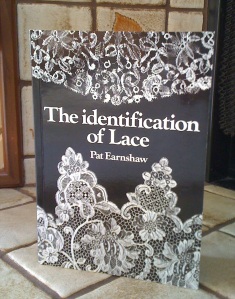 While not my favorite book on this subject, The Identification of Lace does have some good features. Originally published in 1980, Pat Earnshaw’s book was updated in 1994 and republished in 2000. One of the things I do like about this book is that Earnshaw has written an excellent history of lace; pinpointing its’ place in society and how lace has changed with the times. She also organizes the book by dividing it into four sections based on the four ways lace is made (e.g. embroidered, needlepoint, bobbin and machine/craft). I found the information on machine made lace very interesting as Earnshaw goes into great detail about the specifics of this method of production.
 Late in his life, Doyle began speaking of his belief in spiritualism — the idea that the spirit lives on after it leaves the body. 7 focuses heavily on this aspect of Doyle’s beliefs.
